
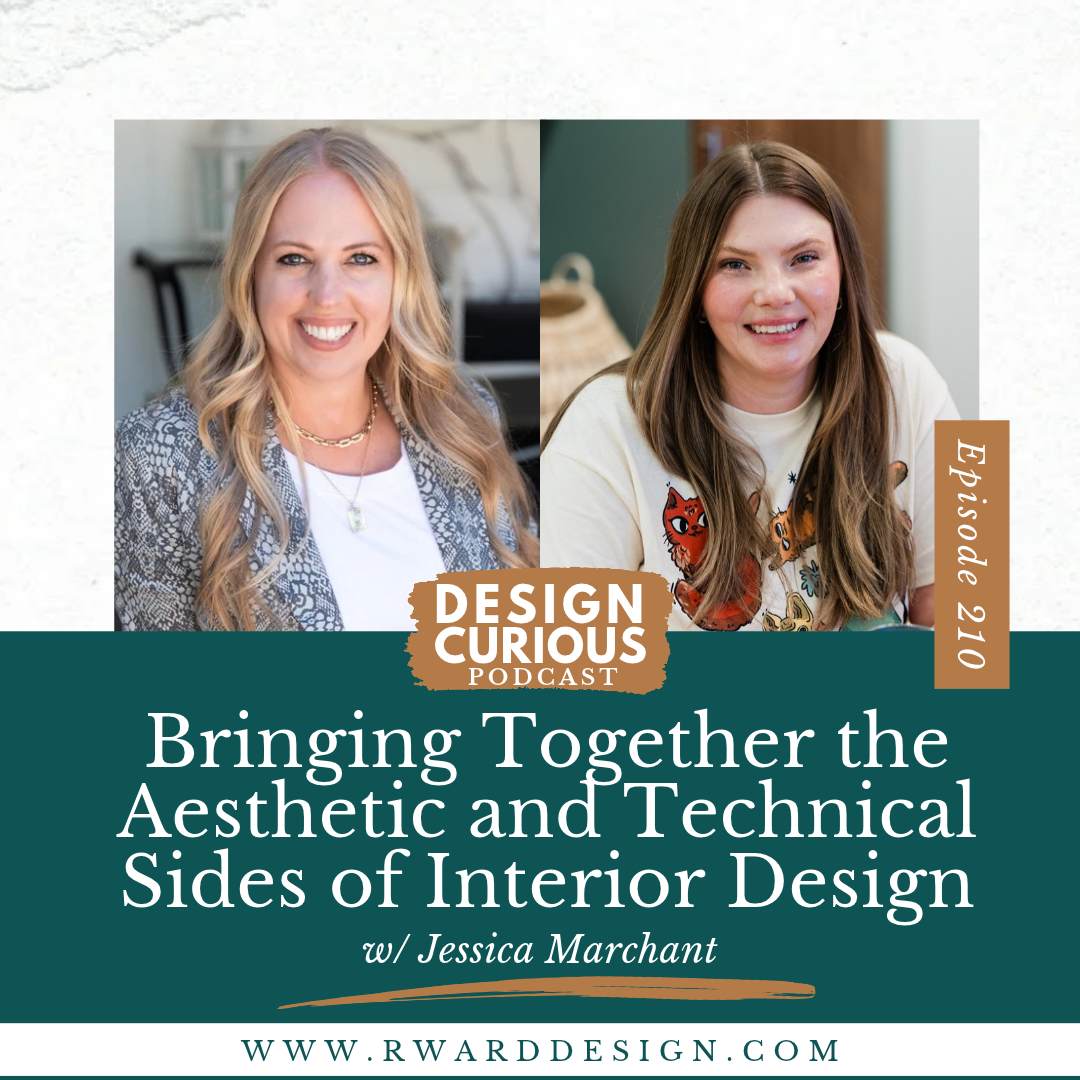
Interior designers love the beautiful, creative side of the work. They love choosing materials, working with clients, selecting furnishings, and bringing a vision to life. But when a project moves into renovation, remodeling, or new construction, another side of interior design becomes just as important: the technical side.
I see this gap often, especially with designers who are moving from decorating and furnishing into more complex residential or commercial projects. You may be confident in your aesthetic skills but feel intimidated by construction documentation, building drawings, space planning, technical details, or understanding how everything will actually be built. And if that technical knowledge wasn’t a major focus of your interior design education or career, it can become a real weak spot. In this episode, Jessica Marchand and I talk about exactly why this matters and what you can do about it.
Interior design is really two distinct crafts—the aesthetic craft and the technical craft—and great projects happen where those two worlds meet. You don’t have to be brilliant at both. But the work does.
What You’ll Learn in This Episode
Why technical design knowledge matters in complex projects
How construction documentation protects your design decisions
When to outsource technical design support
How to choose the right GC partner
Why intentional teams help interior designers scale
Bringing the Aesthetic and Technical Sides Together of Interior Design
One of my favorite ideas from this conversation is that interior design isn’t just one skill. It is really two different crafts working together.
One side is aesthetic: materials, furnishings, soft goods, client interaction, and the creative vision.
The other is technical: figuring out how that vision will actually be built through space planning, construction documentation, drawings, technical details, and coordination with contractors.
Jessica naturally gravitated toward the second side, while many designers naturally gravitate toward the first. And when those two worlds come together, that’s where phenomenal projects can happen.
1. Name Which Side Is Yours
One of the most useful things you can do as an interior designer is honestly identify your strengths.
Jessica knew fairly early in design school that furniture and soft goods weren’t really her thing. While other students loved spending time in the resource room, she found herself in the CAD lab, fascinated by the software and technical work. That self-awareness eventually helped her build a career around what she genuinely enjoyed.
I think that’s an important lesson for all of us. You don’t need to force yourself to become equally brilliant at every part of interior design. Instead, understand what you love, understand where you’re strong, and then be honest about the other areas.
If technical design isn’t your strength, that doesn’t make you less of a designer. But you do need to recognize that technical design still has to happen if you’re taking on complex construction projects.
2. Don’t Let a Technical Weak Spot Stop Your Growth
A lack of construction knowledge can become especially noticeable when you’re transitioning into renovation, remodeling, or new construction.
Jessica explained that technical design is taught in interior design school, but students can sometimes choose how deeply they pursue it. Everyone may learn how to draw floor plans and elevations, but not everyone goes deeper into section drawings, construction details, and the other technical aspects of building.
So if you’re a designer who feels intimidated by construction documentation or building drawings, you’re not necessarily behind. You may simply need more exposure and experience.
The solution is not to pretend you know something you don’t. The solution is to go get the knowledge or support you need. That could mean learning technical design yourself, working alongside someone who has that expertise, or outsourcing that portion of the project to a technical design professional.
Jessica’s own business was created around this exact need. Blue-Sky Creative allows designers to bring in technical support when they need it rather than trying to become experts in every part of the process themselves.
3. Use Construction Documentation as Your Project’s Safety Net
If you’re taking on construction projects, please don’t underestimate the value of good drawings.
Jessica shared a great example of what can happen when a project relies too heavily on verbal communication. A designer may have a great relationship with a general contractor and think drawings aren’t necessary because everyone understands the plan. But eventually, someone on site may interpret something differently. Tile can be installed in the wrong direction, for example, creating thousands of dollars in wasted material, labor, and time.
A construction drawing gives everyone something concrete to work from. Jessica described it as your “receipt.” If a mistake happens—and we’re all human—you can go back to the drawings, see what was intended, and move forward from there.
That’s why construction documentation isn’t simply paperwork. It supports communication, protects design decisions, helps contractors understand the intent, and can help prevent expensive mistakes during construction.
4. Build the Right Technical Team Around You
You also don’t have to do every technical task personally.
Jessica has built Blue-Sky Creative as a team that supports designers with everything from as-built information and CAD drawings to space planning, construction documentation, and renderings. Her team works on both residential and commercial projects, ranging from smaller spaces to extremely large homes and complex projects.
I love this idea of thinking about your business as a team rather than believing you have to be the expert in everything.
Jessica also shared that she wishes she had hired a business coach earlier because she believes she could have grown much faster with the right support. She has since intentionally built a team of seven and emphasized how important it is to bring the right people into your business.
That’s an important business-scaling lesson for interior designers: you don’t grow by doing everything yourself. You grow by knowing what you should own, what you should learn, and what you should outsource.
5. Be Intentional About Your Construction Partners
If you’re moving into your first renovation or construction project, Jessica has one particularly important recommendation: start building relationships with good general contractors in your area.
But don’t simply choose the first GC who comes along. Be intentional.
Your general contractor can make or break a construction project, so you want to find someone whose expectations, communication style, and standards align with yours. Jessica recommends discussing those expectations openly and making sure both the designer and GC understand what they need from one another.
I especially liked her point about site decisions. A seemingly small change during construction can affect other parts of the design. That’s exactly why technical design, construction documentation, and good project management matter.
When you bring the aesthetic and technical sides together—and when your designer, technical team, and GC are all communicating clearly—you give the project a much stronger foundation.
Final Thoughts
You don’t have to love every part of interior design. Maybe you’re the designer who loves the materials, furnishings, client relationships, and the creative vision. Maybe you’re the person who loves CAD, construction documentation, technical details, and figuring out how things are built. Neither side is more important than the other. The great project needs both. So name honestly which half is yours, and then go, get the other half through education, collaboration, outsourcing, or the right team. That’s not a weakness. That’s smart design management and smart business management.
Meet Jessica Marchant
Jessica Marchant is the founder of Blue-Sky Creative, a technical design firm that partners with interior designers nationwide to provide white-label design support, space planning, build-ready construction documentation, and realistic 3D renderings. Her team helps bridge the gap between interior designers and contractors so designers can confidently execute residential and commercial projects. Jessica is a formally trained interior designer with a master’s degree in design management and has experience in kitchen and bath design, construction, themed entertainment, and project management. She also coaches interior designers who are transitioning into more complex renovation and new construction work. Her approach combines technical design expertise with practical business strategy to help creative businesses scale with confidence.
Connect With Jessica Marchant
Website: Blue-Sky Creative
Instagram: @blue_skycreative
Your Next Steps
If you’re serious about building your interior design career or growing your interior design business, you don’t have to figure everything out alone.
My Design Mentor is designed to give you the support, education, and community you need to keep moving forward. Inside, you’ll find 12 learning modules, a book club, special projects, a community of designers for feedback, and monthly one-on-one coaching calls with me where we can focus on the specific challenges you’re facing in your career.
Join My Design Mentor and let’s build your design career together.

Check Out Our Spotify Playlist!

Free Webinar
- “From Passion to Profit”: Learn the 5 Money Moves to start your interior design business right
- Are You Ready to Start Your Interior Design Business? How to Know for Sure (and What It Really Costs to Launch)
Resources & Freebies
- Your Roadmap to a Career in Interior Design
- Furnishings Investment Guide
- Remodel Budget and Timeline Guide
- 3 Things I Wish I had known when I Started my Career
- The best books every interior designer should have
Take a Quiz!
- Find Your Perfect Interior Design Style if you are curious about your design style
- Find Out What Type of Interior Designer You Should Be!
Let’s Connect!
- Email me at [email protected] if you have suggested topics
- DM me on Instagram at @rwarddesign if you have a burning question
Subscribe & Review!
If you love this episode, don’t forget to hit subscribe and leave me a rating & review! Click here.