
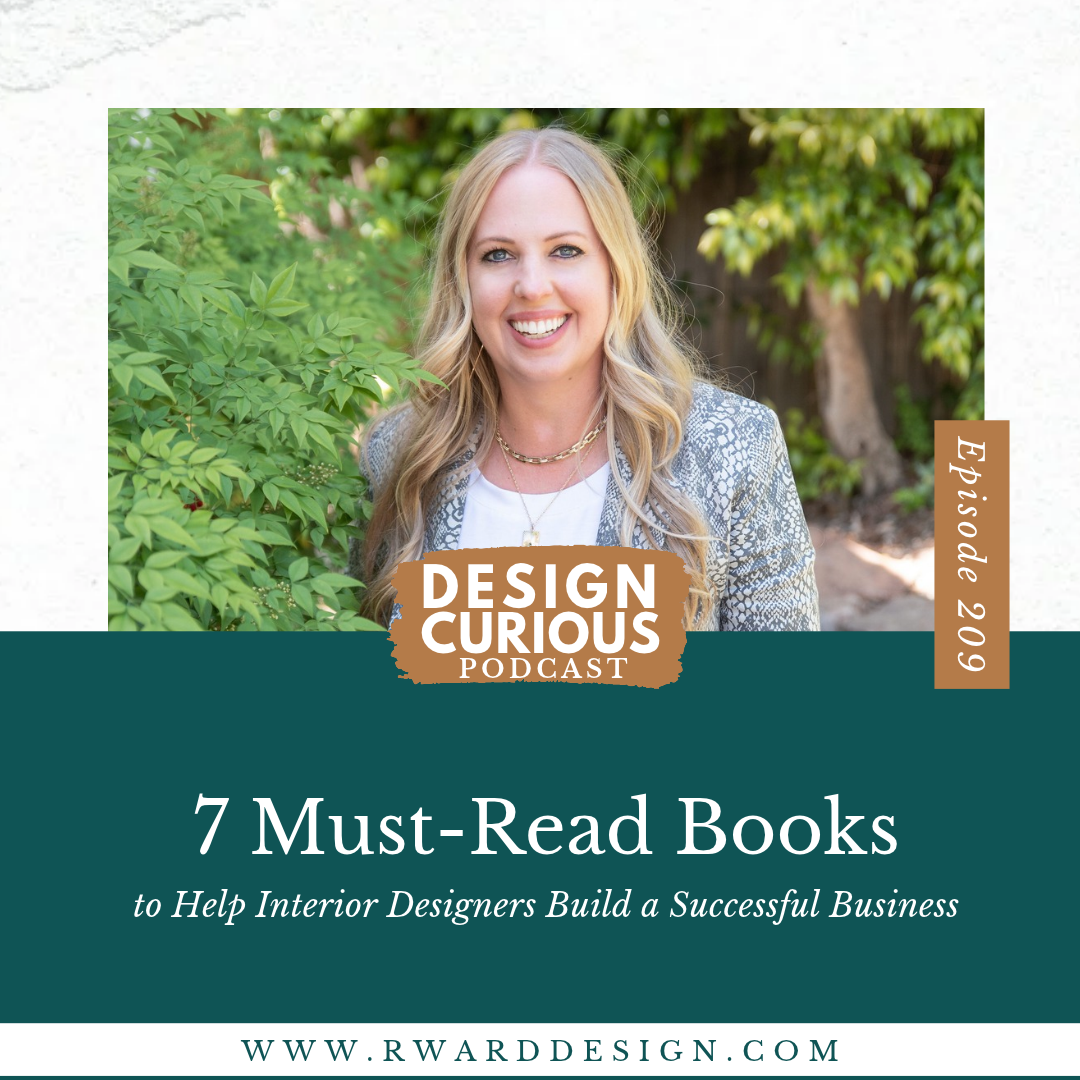
You became an interior designer because you love design. You know how to create beautiful spaces, solve design problems, make thoughtful selections, and bring a client’s vision to life. But once you start your own interior design business, you quickly discover that being a talented designer is only one part of the job.
Suddenly, you’re also responsible for marketing, sales, client experience, project management, finances, systems, leadership, and all the decisions that come with running a business. It can feel overwhelming because nobody necessarily teaches you how to make that transition from skilled creative to confident business owner.
One way I’ve grown my business over the years is through reading. I’ve read a lot of business and personal growth books over the last 10 years, and some have completely changed the way I think about my career, my clients, my money, and my business. In this episode, I’m sharing seven books that have helped me answer important questions about building an interior design business that is profitable, sustainable, memorable, and capable of growing beyond me.
My recommendation: Start with the book that speaks to the question you’re asking in your business right now. Sometimes one idea or one important shift in perspective is enough to make an entire book worthwhile.
What You’ll Learn in This Episode
Why your interior design business exists
How to make your marketing more client-focused
Ways to create a memorable client experience
How systems can help your business grow
How to develop a healthier money mindset
7 Must-Read Books for Interior Designers
Reading a business book is helpful, but the real value comes from what you do with what you’ve learned. I’ve found that books become much more meaningful when you connect their ideas to the stage of business you’re currently in.
Here are the seven books I recommend most for interior designers who want to build a stronger business.
1. Start With Why: Understand Why Your Business Exists
The first book is Start With Why by Simon Sinek, and I talk about this quite often because I think understanding your “why” is such an important foundation for an interior design business.
Before you worry about your logo, pricing, website, or social media strategy, think about why your business exists. Why did you decide to become a business owner? Why do you want to help people with their homes? What do you want your design work to change in your clients’ lives?
For me, design is about enhancing people’s lives by creating beautiful, purposeful homes that are intentionally designed for the people who live in them. Your why might be completely different, and that’s the point.
Your why becomes a filter for your services, ideal clients, marketing, team, and business decisions. It can also help you communicate why someone should choose your interior design firm instead of another talented designer.
This is one of the first things we explore in my Launch Your Business Bootcamp because starting a business is an important life decision. I don’t want you to do it just because you think you’re supposed to. I want you to understand what you’re building and why.
2. Building a StoryBrand: Make Your Client the Hero
The second book is Building a StoryBrand by Donald Miller, which had a big influence on the way I think about marketing and messaging.
One of the biggest lessons is that your client should be the hero of the story—not you.
Think about Star Wars. The designer is more like Obi-Wan, the guide who has the knowledge and experience to help Luke Skywalker, the hero, get where he wants to go. You’re the expert, but your client is the person with the problem, the dream, and the desired happy ending.
This is especially important for interior design websites and marketing. A lot of designer websites focus almost entirely on the designer: here’s my portfolio, here’s my experience, here’s what I do. But the client is really asking, “Do you understand me?” and “Can you help me?”
Your messaging should clearly communicate who you serve, what problem you solve, what working with you looks like, and what your client’s life could look like after working with you.
Use this approach throughout your website, discovery calls, proposals, contracts, service descriptions, and social media content. Keep bringing the story back to what’s in it for the client.
3. Unreasonable Hospitality: Create a Memorable Client Experience
The third book is Unreasonable Hospitality, which is based in the restaurant world but has so many valuable lessons for interior designers.
The idea is to go beyond simply meeting expectations and look for thoughtful ways to surprise and delight your clients. And I think this is especially powerful in an interior design business because the client experience can become one of your greatest differentiators.
Think about what your client experiences from the first inquiry through installation and the final reveal. Are you easy to get ahold of? Do clients know what’s happening next? Are you anticipating their questions? Are you reducing decision fatigue instead of making them make even more decisions?
Maybe your client absolutely loves their dogs, and you remember that when designing their home. Maybe you make a presentation feel special with snacks and drinks. Maybe you remember an important birthday or anniversary. Maybe you thoughtfully plan what happens on installation day so your client can step away and enjoy the experience.
These don’t have to be extravagant gestures. Small, thoughtful details can create a memorable client experience.
And remember, happy clients are more likely to give you referrals. When people have a great experience working with you, they have a story to tell their friends and family. That kind of word-of-mouth marketing is incredibly valuable for an interior design business.
4. The E-Myth Revisited: Work on Your Business, Not Just In It
The fourth book is The E-Myth Revisited by Michael E. Gerber, and this is a real eye-opener for creative business owners.
Most interior designers start a business because they’re good at design. That’s completely understandable. You have a skill, you love the work, and you want the autonomy and flexibility that come with being your own boss.
But once you own the business, you’re no longer just the designer.
You’re also the salesperson, marketer, bookkeeper, project manager, and CEO.
That’s a lot of hats.
The important lesson from this book is that you have to spend time working on your business, not just working in your business. Your design skills may be what started the business, but they aren’t enough to build a sustainable company.
You need business systems, processes, financial structure, marketing strategies, and leadership skills. Otherwise, you can end up creating a job for yourself rather than building a business that gives you the freedom you originally wanted.
5. Built to Sell: Build a Business That Can Thrive Without You
The fifth book is Built to Sell by John Warrillow, and this one takes the idea of systems even further.
A lot of interior designers don’t think of a service-based design business as something that could ever be sold. But if the entire business depends on you, your relationships, your knowledge, and your ability to personally complete every task, then it becomes very difficult to build something that has value beyond you.
The principles in this book encourage you to build a company that can operate without you.
Even if you have absolutely no intention of selling your design business, I still think this is a valuable goal. Why? Because a business that doesn’t need you every minute gives you freedom.
You can take a vacation. You can hire people to do parts of your job. You can step away without everything falling apart. You can come back when you want to contribute instead of being required to do everything.
That’s what scaling, systems, delegation, and sustainable business growth can ultimately provide.
6. You Are a Badass at Making Money: Examine Your Money Mindset
The sixth book is You Are a Badass at Making Money by Jen Sincero, and this is about your relationship with money.
This is something I think every interior designer should spend time thinking about because your money mindset can influence the way you price your services, talk to clients, sell your work, and make business decisions.
You might find yourself wondering, “Do I really deserve to make $300,000 a year from my design business?”
Or maybe your client believes they don’t deserve to spend $12,000 on a sectional.
These thoughts and beliefs can come from experiences and messages we’ve absorbed throughout our lives. Sometimes scripts run in our heads that we’re not even aware of.
Understanding your own money mindset helps you become more aware of those beliefs. And when you understand your relationship with money, you can also become more thoughtful about how money shows up in your interactions with clients.
I especially like this book because Jen Sincero’s approach is fun and approachable. It’s also a good audiobook if you prefer listening to reading.
7. Profit First: Take Control of Your Cash Flow
The seventh book is Profit First by Mike Michalowicz, and this is especially important if you want to build a profitable interior design business.
It’s very easy for money to disappear when you don’t intentionally tell it where to go. That’s why cash flow management is so important.
Traditional accounting looks at revenue minus expenses and determines profit from what’s left. Profit First takes a different approach by intentionally allocating profit first, even if it’s a small percentage.
The system also encourages you to separate money into designated accounts. This can help you clearly see your owner’s compensation, taxes, operating expenses, profit, and cash reserves instead of allowing everything to become one big pool of money.
For me, this has been incredibly helpful because I wasn’t naturally inclined to create a lot of structure around money management. Using the Profit First method helped me understand what was happening with my money and make sure that money set aside for taxes wasn’t mixed in with the money I needed for rent, products, or other expenses.
If you want your interior design business to be financially healthy, profitability and cash flow can’t be an afterthought.
Don’t Just Read the Book—Apply the Lesson
You don’t need to read these seven books in one sitting, and you don’t need to implement every single idea you encounter.
I’ve read these books over the course of many years. And I’ve also found that sometimes a book will find you at exactly the right stage of your business. You might read something early in your career and not completely understand why it’s important. Then, several years later, you read it again, and suddenly the lesson makes sense because you’ve experienced the problem yourself.
That’s why I encourage you to start with the book that speaks to the question you’re asking right now.
Are you struggling to explain your value? Start with Building a StoryBrand. Are you overwhelmed by all the hats you’re wearing? Pick up The E-Myth Revisited. Are you struggling with money or cash flow? Try You Are a Badass at Making Money or Profit First.
And remember: you don’t have to implement everything. One important shift can make a book worthwhile.
Final Thoughts
These seven books have helped me work through some really important questions: Why does my business exist? How do I communicate its value? How do I create a memorable client experience? How do I build systems that work for me instead of requiring me to do everything myself? How do I create a business that can thrive beyond me? What do I believe about earning and spending money? And how can I manage my money intentionally?
My motto is always, “Always be reading,” because I believe reading can help you grow not only as an interior designer, but also as a business owner, leader, and person.
Your Next Steps
If you’re serious about building your interior design career or growing your interior design business, you don’t have to figure everything out alone.
My Design Mentor is designed to give you the support, education, and community you need to keep moving forward. Inside, you’ll find 12 learning modules, a book club, special projects, a community of designers for feedback, and monthly one-on-one coaching calls with me where we can focus on the specific challenges you’re facing in your career.
Join My Design Mentor and let’s build your design career together.

Check Out Our Spotify Playlist!

Free Webinar
- “From Passion to Profit”: Learn the 5 Money Moves to start your interior design business right
- Are You Ready to Start Your Interior Design Business? How to Know for Sure (and What It Really Costs to Launch)
Resources & Freebies
- Your Roadmap to a Career in Interior Design
- Furnishings Investment Guide
- Remodel Budget and Timeline Guide
- 3 Things I Wish I had known when I Started my Career
- The best books every interior designer should have
Take a Quiz!
- Find Your Perfect Interior Design Style if you are curious about your design style
- Find Out What Type of Interior Designer You Should Be!
Let’s Connect!
- Email me at [email protected] if you have suggested topics
- DM me on Instagram at @rwarddesign if you have a burning question
Subscribe & Review!
If you love this episode, don’t forget to hit subscribe and leave me a rating & review! Click here.